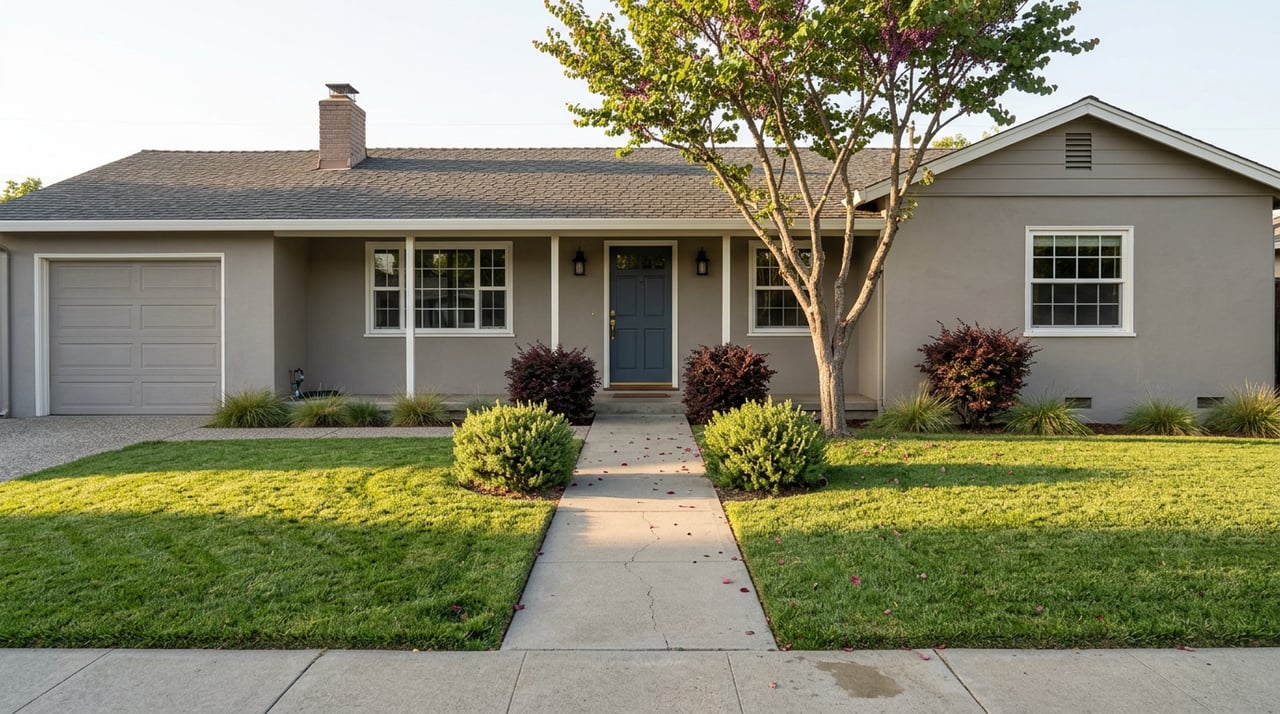
Selling a San Lorenzo Village Home: What Delays Closing?
September 3, 2026
September 3, 2026
San Lorenzo is having one of its tightest markets in recent memory. Altos Research counted just seven active listings in the community for the week of August 11, 2026, with a Market Action Index near 80, the kind of reading that signals a seller's market and upward pricing pressure if the trend holds. That scarcity should make listing a San Lorenzo Village home simple: price it, list it, watch the offers come in.
It usually does, right up until escrow opens the title file.
San Lorenzo Village is not an ordinary tract of postwar ranch homes. It is a planned community built starting in 1944 by the David D. Bohannon Company, one of the first developments in the country to use prefabricated wall framing at scale, a technique known at the time as the California method. That history is part of what makes the neighborhood distinctive. It is also why a home that has been in the same family since the Eisenhower years can carry paperwork that a 1998-built subdivision never will. The friction that slows these sales down rarely comes from the market. It comes from the file.
Many original San Lorenzo Village deeds were recorded with racially restrictive covenant language, a standard practice of the Homes Association era before the U.S. Supreme Court ruled such covenants legally unenforceable in 1948. The language itself lost its force decades ago, but it never disappeared from the paper. It sat in title records, technically void, practically invisible, until California passed Assembly Bill 1466 in 2021.
AB 1466 changed the mechanics of closing on a home like this. Under Government Code Section 12956.2, title companies, escrow companies, and real estate agents are now required to flag any deed containing this kind of language and provide the owner with a Restrictive Covenant Modification form before the sale can close. If the covenant is confirmed by county counsel, a redacted version gets recorded in its place. The process is free to the property owner, but it is a process, and it happens during escrow rather than before it, which means it can add real time to a transaction that would otherwise move in days.
County recorder offices across California, including Riverside, Santa Clara, San Mateo, and Kern, have set up dedicated programs using optical character recognition software to work through millions of archived documents and identify this kind of language. A home whose deed has already been reviewed moves through this step without friction. A home whose deed has not been reviewed does not know which category it falls into until someone checks.
If your family has owned the house since the Village's founding decades, or if the title report your title company pulls references the original San Lorenzo Village Association CC&Rs, that check is worth doing before you list, not after you're already in contract with a buyer waiting on it.
San Lorenzo Village is also one of the few East Bay tracts where the original homeowners association never stopped functioning. The San Lorenzo Village Homes Association still requires an Architectural Application Form for any exterior modification, and its scope is broad. Even trimming or removing a front yard street tree requires board approval before the work happens.
The association's own language explains the intent plainly. Its CC&Rs exist to establish the highest possible property values by protecting the lot owners against improper use of surrounding lots, and the association has enforced standards like these since it was formed in 1945, shortly after the Village broke ground.
For a seller, this matters in a specific way: any addition, garage conversion, or accessory dwelling unit built without an approved application leaves a gap in the paper trail that a buyer's inspector or lender may ask about. The Association's ADU and JADU policy, approved in May 2025, requires new units to incorporate the period aesthetic standards existing throughout the community, meaning window grids, roof pitch, and general character have to match the tract rather than the owner's preference. A converted garage that never went through the Architectural Control Committee is not automatically a problem, but it is a question, and questions during escrow cost time.
Before you list, it's worth pulling together:
None of this is disqualifying. All of it is faster to produce before a buyer's agent asks for it than after.
The physical house tells its own version of the same story. Most homes in San Lorenzo Village were built in the late 1940s and 1950s, which puts the original galvanized supply lines and cast iron drain systems in many of these houses well past the seventy-year mark, according to local plumbing contractors who work the area regularly. Galvanized pipe corrodes from the inside out, so a home can show reasonable water pressure right up until a section fails. Cast iron drains follow a similar pattern, staying serviceable until they don't.
This isn't a defect unique to any one house. It's the baseline condition of a home this age that hasn't been repiped, and buyers' inspectors in this market know to look for it. A sewer camera inspection before listing tells you exactly what you're dealing with rather than leaving it to a buyer's inspector to discover during their contingency period, when a surprise finding has more leverage to reopen negotiations than a known one disclosed up front.
Here's where the numbers actually matter, and where they disagree with each other in a way worth sitting with. Movoto's snapshot for August 2026 put the median list price at $802,000, down about 4 percent from August 2025. Zillow's home value index, last updated in June 2026, showed values down roughly 7.5 percent over the trailing twelve months. Both track the same neighborhood and land on different magnitudes, but they agree on direction: values have softened over the past year even as pace has stayed brisk.
That combination is the actual condition sellers are working with. It is not simply a hot market where anything sells. It is a market where inventory is scarce enough that well-prepared homes move quickly, but where price growth has cooled enough that buyers and their agents have room to be selective about the homes that aren't. An updated San Lorenzo Village home, with newer kitchens, bathrooms, and systems, tends to sell above the median. An original, untouched example still sells, but it competes on story and price rather than assumption.
| Condition | What it typically means at listing |
|---|---|
| Fully updated, systems replaced | Competes above median, faster path to multiple offers |
| Original systems, cosmetically updated | Standard timeline, buyer's inspector focuses on plumbing and electrical |
| Untouched since original construction | Needs clear as-is pricing, may draw investor interest |
The math is straightforward once you separate the two things that are actually happening. The market itself is working in your favor: seven active listings and a Market Action Index near 80 mean a well-priced home in this community doesn't sit. What slows a sale down is paperwork that has nothing to do with market conditions and everything to do with the house's own history.
None of these steps require you to slow down your timeline. They require you to start them before a buyer's offer is already on the table and the clock is already running.
Does every San Lorenzo Village home have a restrictive covenant on its deed? No. The language appears on many original-era deeds but not all of them, and only a title search confirms whether it's present on a specific property.
Will fixing HOA paperwork gaps delay my listing? Usually not. Gathering existing approval records takes days, not weeks, and it's far faster to do before a buyer's agent requests it during a contingency period.
Is a home with original galvanized plumbing still sellable as-is? Yes, with pricing that reflects the condition. Many buyers in this price range expect some original systems and price accordingly once they understand the actual condition rather than guessing at it.
If you're weighing whether to prep or price a San Lorenzo Village home for this fall's market, Bert Aranda has spent decades working East Bay transactions exactly like this one. Get a free home valuation and a straight read on what your specific property's history means for the sale before you list.
This article is general information, not legal, tax or financial advice. Consult a qualified professional about your situation.

Get assistance in determining current property value, crafting a competitive offer, writing and negotiating a contract, and much more. Contact me today.